
Your Financial Results Are Telling You Something — Are You Asking the Right Questions?
Most management teams spend a significant amount of time reviewing financial results.
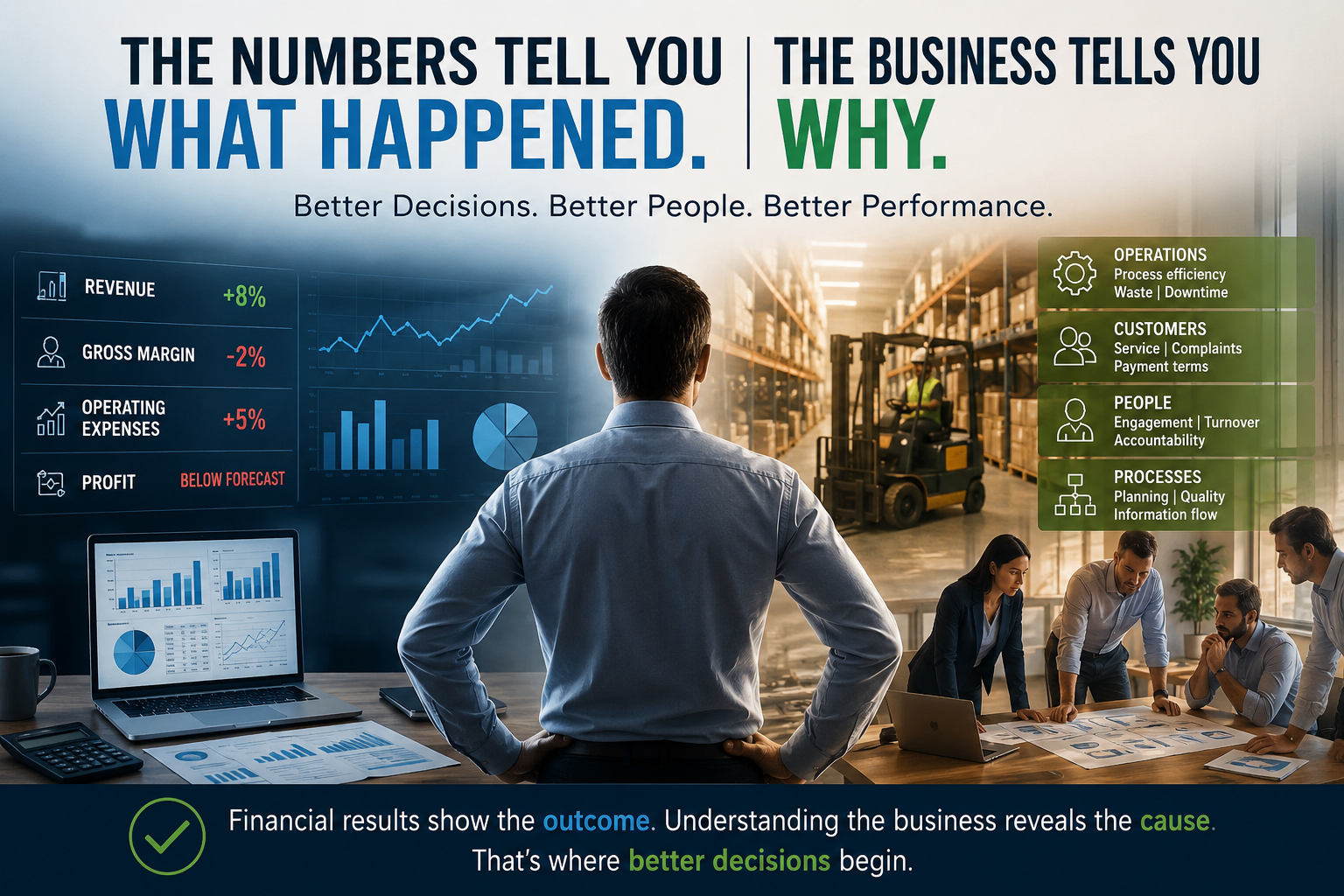
Revenue is up 8%.
Gross margin is down 2%.
Operating expenses are above budget.
Profit is below forecast.
Those numbers matter.
But they rarely tell you why something happened.
Financial statements are a record of thousands of decisions and actions that have already taken place throughout the business.
A declining gross margin might be a pricing problem.
Or it could be excessive production waste, poor asset performance, poor purchasing, overtime, product mix, discounting or inaccurate costing.
Rising staff costs might indicate overstaffing. Or they may point to excessive overtime, inefficient processes, ineffective management—or a combination of all four.
The financial statements identify the symptom.
Good management needs to understand the cause.
Start with the numbers — but don't stop there
Financial information remains one of the most important tools available to any business owner.
The problem arises when management reviews the numbers in isolation.
Suppose gross profit falls from 32% to 28%.
The immediate response might be:
"Our costs are too high."
Maybe.
But which costs?
And, more importantly, why have they increased?
Have raw material prices increased without the business being able to pass those increases on to customers?
Has production waste increased? Is this as a result of inefficient processes, inefficient equipment, or some other reason?
Are employees working more overtime? Why?
Has the sales mix changed towards lower-margin products?
Are salespeople discounting to win business? If so, are you unintentionally resetting customers' expectations of what your product or service should cost?
The financial results give you a place to start looking. They don't necessarily give you the answer.Follow the number into the business
One of the most useful activities management can conduct is following the financial results back into the business.
If inventory increases, it is not simply a change in a number on the balance sheet.
Walk through the warehouse.
Ask what is sitting there and why.
Is it slow-moving stock? Poor quality from a supplier?
Has the buying team bought too much?
Are minimum order quantities driving excess inventory?
Is production planning inaccurate?
Are sales forecasts unreliable?
The answer won't be found in the inventory balance. It will be found in understanding why the inventory is there.
Similarly, if debtor days increase, don't simply tell the finance team to collect faster.
Look at what is happening before the invoice becomes overdue.
Are invoices being sent promptly?
Are there customer disputes?
Are credit notes taking too long to process?
Are customers experiencing financial difficulty? Are your credit limits still appropriate?
Are salespeople agreeing to payment terms that don't match the company's requirements?
Are customers unhappy with the product or service?
While working with a client to improve their cash flow, we identified an opportunity to bring a production process in-house that had previously been outsourced to a supplier. The change improved cash flow, but the benefit went much further. Bringing the process in-house also added almost R1 million directly to the company's bottom line.
The solution to a financial problem wasn't found in the financial statements. It was found in the way the business operated.
Sometimes what appears to be a finance problem has very little to do with finance.Understand the relationship between people and performance
This is an area businesses often pay too little attention to.
But people decisions eventually become financial results.
Poor supervision can lead to lower productivity.
Poor communication can lead to mistakes, rework, unhappy customers and even lost contracts.
High employee turnover increases recruitment and training costs and results in the loss of valuable experience. More importantly, high turnover may be telling you something about what is happening inside the business.
Absenteeism can increase overtime and place additional pressure on other employees.
Weak accountability allows problems to continue longer than they should.
On the other hand, capable managers and engaged employees can have a positive impact on productivity, customer service, quality and profitability.
Employee relations should never be viewed purely as an HR responsibility. It is a business performance issue.
The challenge for management is to understand the connection between what is happening with their people and what eventually appears in the numbers.Measure what drives the result
Many businesses have plenty of financial information but surprisingly little operational information.
A monthly income statement tells you what happened.
Good management information should also help you understand what is driving it.
The right measures will differ between businesses, but they might include:
- Production output and efficiency
- Scrap and rework
- Customer complaints and returns
- Inventory days
- Debtor days
- Overtime
- Absenteeism
- Employee turnover
- Sales conversion rates
- Average selling price
- Gross margin by customer or product
- On-time delivery
The objective isn't to create another complex spreadsheet that nobody understands.
It's to identify the few key measures that genuinely explain how the business is performing—and then use those measures to ask the most important question: why?
If you measure only the financial outcome, you're often measuring the business too late.Get management out of their silos
Finance understands the numbers.
Operations understands production.
Sales understands customers.
HR understands employee matters.
But here’s the thing - The customer doesn't experience four different departments. They experience one business.
The same applies to business performance.
A sales decision can affect production.
A production decision can affect inventory—and inventory decisions can affect production.
Inventory affects cash flow.
Cash flow affects your ability to pay the bills.
And people affect all of them.
That's why some of the most valuable management conversations happen when different functions look at the same problem together.
Instead of asking:
"Why did sales miss the forecast?"
Ask:
"What happened in the business that caused us to miss the forecast?"
That's a very different conversation.
Ask better questions
Good management information should create questions, not simply provide answers.
When reviewing performance, consider asking:
- What changed?
- Why did it change?
- Is it temporary or is there a trend developing?
- What is happening operationally that explains the financial result?
- Who owns the underlying issue?
- What action are we taking?
- How will we know whether that action worked?
Those questions turn a management meeting from a review of history into a discussion about improving the future.
The numbers tell you what happened. The business tells you why.
Financial statements are essential.
But sustainable improvement rarely comes from analysing the numbers alone.
It comes from understanding the decisions, people, processes and behaviours that created those numbers in the first place.
That requires management to look at the business as a whole as opposed to individual departments in isolation.
The objective isn't simply better reporting.
It's better understanding.
Because better understanding leads to better decisions—and better decisions ultimately lead to better business performance.
Better Decisions. Better People. Better Performance.
If your management reports tell you what is happening but don't give you enough insight into why, it may be time to look beyond the numbers.
At ZM Advisory, we work with business owners and management teams to identify the financial and operational drivers of performance and turn that insight into practical action.
If you'd like to understand what's really driving performance in your business, let's have a conversation.