
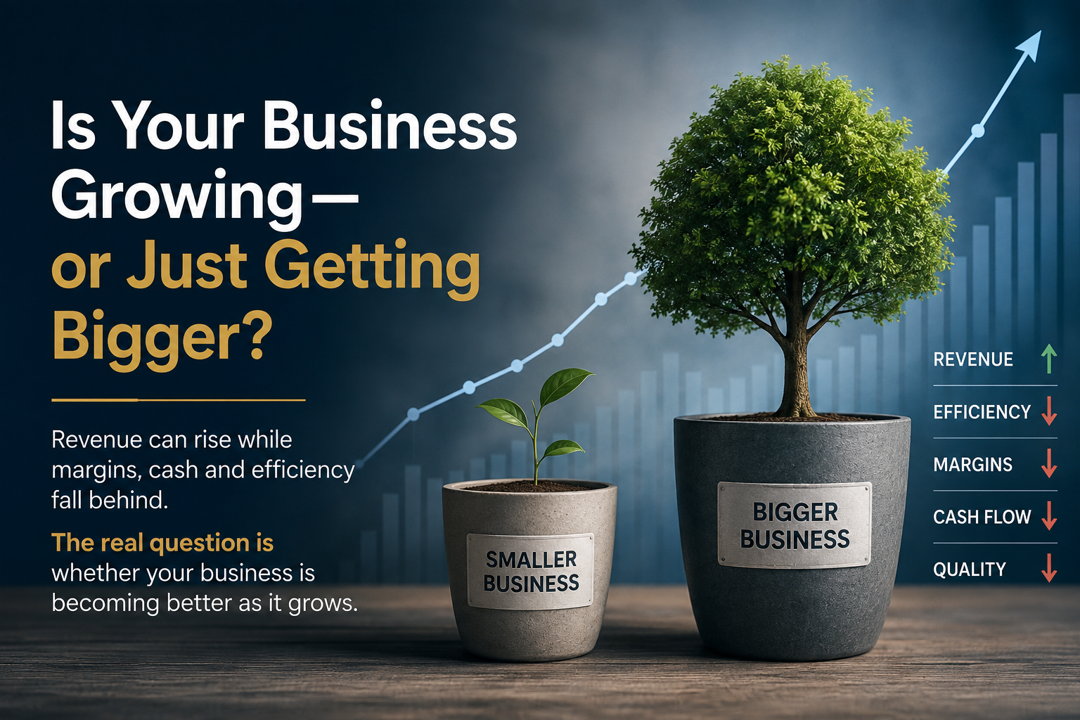
Growth is something almost every business owner wants.
More customers. More revenue. More employees. A bigger operation.
And when turnover is growing year after year, it’s easy to assume the business is doing well.
But is it?
I worked with a business that was growing at around 20% per annum.
On the surface, the numbers looked good. Revenue was increasing and the business was getting bigger.
But underneath the surface, problems were starting to appear.
Quality had dropped. Rework was increasing. Unnecessary overtime had become a problem. Processes that had worked when the business was smaller were struggling with the increased volumes.
The growth didn’t cause these problems. It just exposed weaknesses in the business that were manageable at a smaller scale.
The business was growing. But was it actually becoming a better business?
That is an important distinction.
Because growth in revenue doesn't necessarily mean growth in performance.
A business can get bigger while margins decline, cash flow comes under pressure, processes that worked become less efficient and management struggles to keep up.
Sometimes growth can camouflage the problems that eventually start holding the business back.
Growth Exposes Weaknesses
Many businesses develop their processes and systems as they grow.
A spreadsheet is created to solve a problem.
An approval process is introduced.
Someone takes responsibility for ordering stock.
The owner approves certain decisions.
A manager develops their own way of reporting.
At a smaller scale, these things can work perfectly well.
But add more customers, employees, transactions and higher production volumes, and suddenly the weaknesses start becoming visible.
A process that wastes ten minutes may not seem significant when it happens five times a week. It becomes a very different problem when it happens fifty times a day.
A purchasing process that relied on one person’s knowledge becomes a risk when the number of suppliers and products doubles.
A production problem that could previously be resolved quickly starts creating rework, overtime and delayed deliveries when volumes increase.
What worked for the business you were may not necessarily work for the business you have become.
That is why growth requires businesses to periodically question the way things are being done.
Revenue Can Hide Inefficiency
One of the dangers of rapid growth is that increasing revenue can make deteriorating performance less obvious.
Overtime increases — but production is growing.
Headcount increases — but there are more customers to service.
Stock increases — but sales are increasing.
Operating costs rise — but turnover is higher.
Margins fall slightly — but gross profit in Rand terms is still growing.
There may be perfectly reasonable explanations for each of these.
But taken together, they may also be telling you that the business is becoming less efficient as it grows.
This is why looking at turnover alone becomes dangerous.
A business growing revenue at 20% while costs are growing at 25% has a very different problem from a business growing both revenue and productivity.
Growth should not only create more revenue. It should ultimately create a stronger business.
The Numbers Are the Starting Point
The financial results can often provide the first indication that something isn't working.
Is gross margin falling?
Are employee costs increasing faster than revenue?
Is overtime becoming a permanent feature?
Is inventory growing faster than sales?
Is the business profitable but constantly short of cash?
Is operating profit failing to keep pace with turnover?
Those questions tell you where to start looking.
But they don't necessarily tell you what is causing the problem.
If overtime has increased, cutting overtime may appear to be the obvious solution.
But the question to ask is: why is overtime increasing in the first place? What if the overtime is being caused by rework?
And what if the rework is being caused by a poor production process?
The overtime is the cost you can see.
The process is the problem you need to solve.
The same applies elsewhere in the business.
A margin problem may be a pricing or operational problem.
A cash-flow problem might start with stock, debtors or a broken process.
An employee-cost problem might actually be a productivity or management problem.
The numbers tell you where to look. Understanding the business tells you why.
Management Has to Grow With the Business
Processes and systems aren't the only things that need to change.
Management does too.
In a smaller business, the owner can often be involved in almost everything.
You approve purchases.
You speak to important customers.
You deal with staff problems.
You watch the bank account.
You make the important decisions.
And when something goes wrong, everyone knows who to ask.
That becomes increasingly difficult as the business grows.
More employees require more management.
More customers create more decisions.
More complexity requires clearer accountability.
If every significant decision still has to pass through the owner, the owner will become one of the main constraints on growth.
Hiring more people doesn't necessarily solve that problem.
The business needs managers who understand what they are accountable for, have the information they need and are able to make decisions.
A bigger workforce without stronger management can simply create a bigger management problem.
Your Information Needs to Grow Too
There is another change that often gets overlooked.
Reporting.
When a business is relatively small, the owner often knows a great deal about what is happening simply by being involved in the operation.
You know the customers.
You know which products are moving.
You know where the problems are.
As the business becomes larger and more complex, that becomes harder.
As the business changes, the information management uses needs to change with it.
Knowing that revenue increased by 15% isn't enough.
Management may need to understand:
Which customers are actually profitable?
Which products are driving margin? And which are a drag on margin?
Where is capacity being lost?
What is causing overtime?
Why is inventory increasing?
Where is cash being tied up?
Which divisions, branches or product lines are performing well?
And where are resources being consumed without producing the expected return?
The reporting that worked for a R10 million business may not be sufficient for a R30 million business.
As complexity increases, visibility needs to improve with it.
Otherwise, management can find itself running a much larger business using information designed for a much smaller one.
Growth Should Create a Better Business
None of this means growth is a problem.
Growth creates opportunity.
It allows a business to employ more people, serve more customers, invest in better systems and create greater value.
But growth also challenges the business.
And these challenges need to be managed.
As the business gets bigger, periodically ask:
Are our processes still appropriate for the volumes we're handling?
Are our systems helping us manage the business or creating more work?
Has our management capability grown with our headcount?
Is our reporting giving us the information we now need?
Are we becoming more productive?
Are margins improving?
Is growth generating cash — or consuming it?
And perhaps most importantly:
Are we building a better business, or simply a bigger one?
Because turnover is only one measure of growth.
If your business is growing but you're not sure whether performance is keeping pace, perhaps it's time to look beyond the top-line numbers.