
Your Business Processes Are Costing You Money - Do You Know Where?
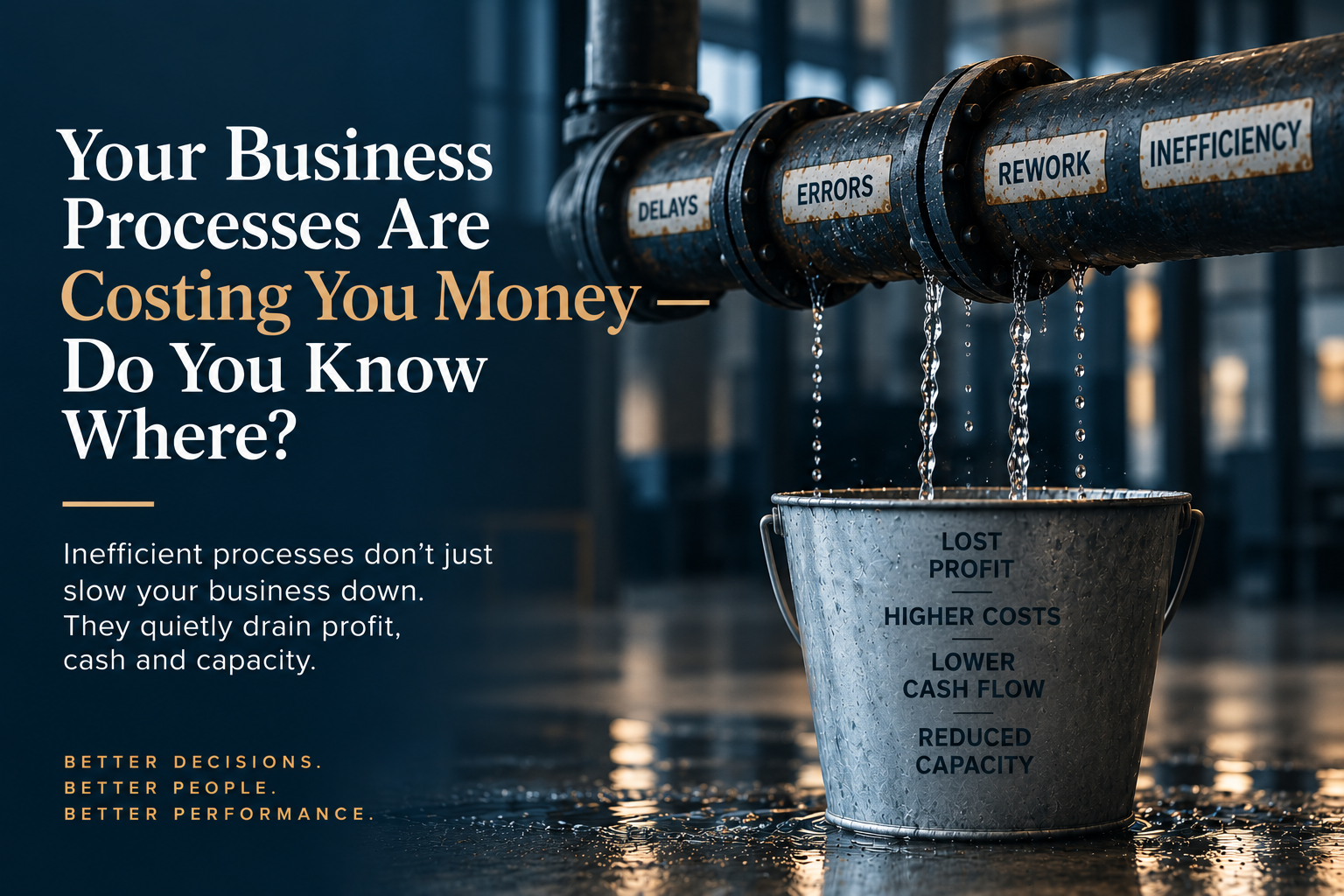
When businesses look for ways to improve profitability, the conversation usually turns to the financial statements.
Where can we reduce costs?
Can we increase prices?
Which expenses have increased?
Those are reasonable questions.
But some of the biggest costs in a business don't appear neatly on an expense line.
They sit inside the way the business operates.
A process takes longer than it should. Work gets done twice. Stock sits for months. Employees wait for information. A customer order moves through five different departments, each pulling in different directions. A production bottleneck creates overtime, delays and stock-outs.
Each problem has a cost.
The difficulty is that the financial statements usually show you that costs increased – not why they increased.
The cost of a poor process
Consider something as simple as an inefficient purchasing process.
A business may order too much stock because purchasing doesn't have reliable demand information.
Storage requirements increase. Some of it may become obsolete. Employees spend more time counting and moving it. And while the business may still be profitable, working capital requirements increase.
The financial statements might show higher inventory and weaker cash flow.
But the underlying problem isn't necessarily financial.
It may be the process used to forecast demand, approve purchases or communicate between sales, operations and procurement.
Trying to solve the cash flow problem without fixing that process means treating the symptom rather than the cause.
Small inefficiencies become expensive
Most inefficient processes don't look dramatic.
They often develop gradually.
A spreadsheet gets added because the system doesn't provide the information someone needs.
An extra approval is introduced after something goes wrong.
A manual check is added because nobody trusts the data.
A manager becomes the person everyone goes to for a decision.
None of these changes necessarily looks expensive on its own.
But repeat them hundreds or thousands of times and the cost becomes significant – problems whose causes are not always visible on a spreadsheet or in a financial report.
The business becomes slower. Management spends more time resolving routine issues. Employees spend time on administration rather than productive work. Customers wait longer. Overtime increases. Errors and rework increase. And over time, revenue can suffer.
And eventually those inefficiencies find their way into the numbers.
A real example
I once worked with a client who was experiencing cash flow pressure.
As we worked through the numbers and into the operation itself, we identified a production process that had been outsourced to a supplier.
The arrangement had become a bottleneck.
Deliveries were irregular, production was disrupted and the business was constantly dealing with stock-outs.
The obvious issue appeared to be cash flow.
But the opportunity was operational.
We brought the process in-house.
Cash flow improved. Production became more predictable. Stock-outs reduced significantly.
And the change added almost R1 million directly to the company's bottom line.
The solution wasn't found by cutting an expense in the income statement.
It came from understanding how the business actually worked.
When was the last time you questioned the process?
One of the most expensive phrases in business is:
"That's how we've always done it."
A process that made sense when the business had ten employees may not make sense when it has fifty.
A system that worked at R10 million turnover may struggle at R50 million.
A control introduced five years ago may no longer serve any useful purpose.
And a workaround that was supposed to be temporary can quietly become part of the way the business operates.
Growth often exposes these problems.
The business becomes bigger, but the processes, systems and management structures don't always grow with it.
Eventually management finds itself working harder simply to keep the business moving.
Where should you look?
You don't need to map every process in the business to find opportunities for improvement.
Start where the symptoms are.
Where are customers waiting?
Where is work regularly delayed?
Where is information captured manually?
Where do errors and rework occur?
Where does everything depend on one person?
Where is stock building up?
Where is overtime consistently high?
Where are managers spending time solving the same problems repeatedly?
Those are often clues that something in the process isn't working as well as it should.
Then ask why.
The 5 Whys technique developed as part of the Toyota Production System is an invaluable way of drilling down to the root cause – and something that we use regularly with our clients.
Don't automate a bad process
Technology can improve efficiency, but it can also make a bad process happen faster.
Before introducing another system, spreadsheet, app or piece of automation, understand the process you're trying to improve.
What is the outcome?
Which steps genuinely add value?
What information is required?
Who actually needs to be involved?
Where are the delays?
What can be removed, simplified or standardised?
Only then should you decide whether technology is part of the answer.
Otherwise, you risk building inefficiencies into the system.
The numbers are the starting point
Financial information remains important.
It can tell you where performance is changing and where you should start asking questions.
Rising overtime.
Falling margins.
Increasing inventory.
Higher employee costs.
Slower collections.
Growing overheads.
Each one is a signal.
But the answer may not be in the financial statements.
Walk through the operation, speak to the people on the ground and understand how information, materials and decisions move through the business.
That's where the real cause often becomes visible.
Better processes. Better performance.
Improving a process isn't simply about cutting costs.
It's about making the business easier to run.
Good processes help people make better decisions.
They reduce unnecessary work.
They make accountability clearer.
They improve customer service.
They release cash and capacity.
And they make growth easier to manage.
The financial benefit is the result of all of those things working better.
So when the numbers tell you something is wrong, don't only ask which cost needs to be reduced.
Ask what is happening in the business to create that cost in the first place.
Because sometimes the best way to improve the numbers is to change the process behind them.
If you suspect that inefficient processes are costing your business money, but you're not sure where the problem lies, let's have a conversation. Sometimes an outside perspective is all it takes to identify what the numbers alone can't tell you.