
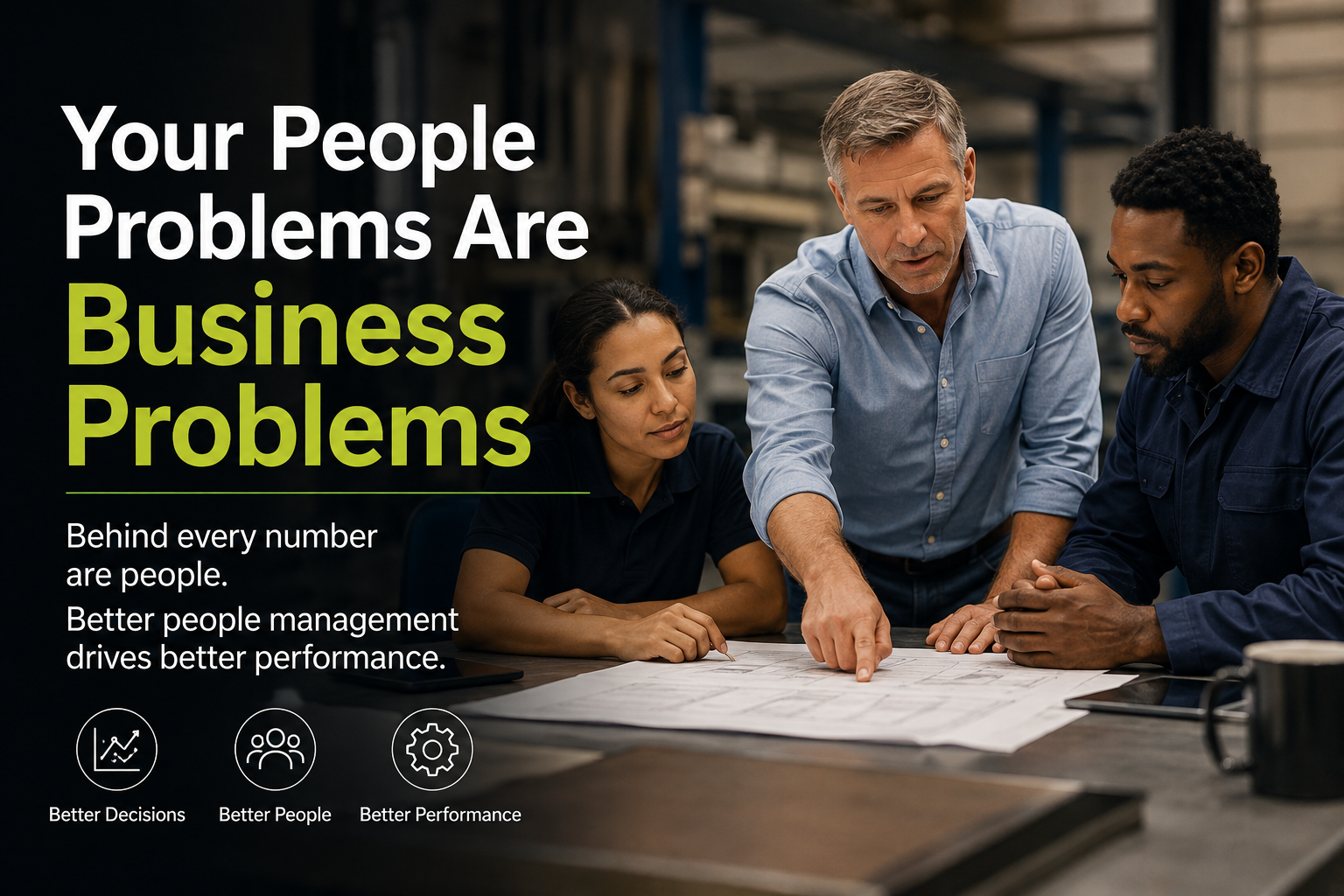
Your People Problems Are Business Problems
When businesses talk about performance, the conversation usually starts with the numbers.
Revenue. Margins. Costs. Cash flow. Productivity. Those metrics are important.
But behind every one of those numbers are people.
People making decisions, managing employees, dealing with customers, operating equipment. And carrying out the processes that ultimately determine whether the business performs or not.
Yet when something goes wrong with people, we often label it an HR problem.
High absenteeism? HR problem.
Poor performance? HR problem.
Employee turnover? HR problem.
Disciplinary issues? Definitely an HR problem.
But is it?
People problems have a financial cost
Take overtime.
A rising overtime bill appears in the financial statements as an increased employee cost.
The obvious response might be to reduce overtime or introduce tighter approval processes.
But before doing that, I would want to understand why the overtime is happening in the first place.
Are you understaffed?
Is absenteeism too high?
Is poor production planning creating unnecessary peaks in demand?
Are employees redoing work because of quality problems?
Is equipment downtime forcing production into overtime?
Are staffing levels simply not keeping up with growth?
Or are managers simply not managing working hours effectively?
At a recent client, excessive overtime initially appeared to be an employee cost issue.
When we looked deeper, however, we found that poor customer scheduling was driving the overtime. Compounding the problem, the project had been poorly costed, which meant the additional overtime ultimately impacted the bottom line.
Simply reducing overtime wouldn't have solved the underlying problem.
In fact, it could have created another one.
The cost appeared in the financial statements. The cause sat somewhere else in the business.
The same applies to absenteeism, employee turnover, poor productivity and disciplinary issues.
Managers manage people
Employee relations is often treated as something for HR to manage.
Management becomes involved when there is a complaint, a disciplinary hearing or some other formal process.
But by then, the underlying problem may have been developing for some time.
Employee relations is shaped every day in the business.
Do managers communicate clearly?
Do employees understand what is expected of them?
Do they have the tools and information they need to do their jobs properly?
Are people treated fairly and consistently?
Are safety standards clearly communicated and enforced?
Can employees raise difficult issues with management?
And are managers prepared to have difficult conversations early, before a small problem becomes a much bigger one?
HR has an important role to play.
It provides the frameworks, processes and specialist support that managers need.
But managers manage people.
That responsibility cannot be outsourced to HR.
Before blaming the employee, understand the problem
When an employee isn't performing, it's easy to conclude that you have the wrong person.
Sometimes you do.
But I'd ask a few questions first.
Does the employee know exactly what is expected of them?
Have they been properly trained?
Do they have the right tools?
Is the process they're expected to follow actually workable?
Are priorities constantly changing?
Does their manager provide direction and feedback?
And perhaps most importantly:
Does anyone actually measure whether the employee is performing?
A performance problem may be caused by the employee.
But it could just as easily be the manager, the process, the system—or a combination of all four.
Replacing the employee without understanding the cause can simply mean putting a new person into the same problem.
A good employee doesn't automatically make a good manager
I've seen technically capable people promoted into management positions because they were good at their jobs.
It makes sense.
Your best salesperson becomes the sales manager.
An experienced technician becomes the workshop manager.
A strong production employee becomes the production manager.
But managing a process and managing people are two very different things.
Managers need to set expectations.
They need to communicate.
They need to plan.
They need to make decisions.
They need to manage conflict and poor performance.
And they need to hold people accountable.
When they don't, the cost isn't always immediately obvious.
Good employees become frustrated.
Poor performance is tolerated.
Problems that should have been resolved at a supervisory level get escalated to senior management.
Employees leave.
Decisions take longer.
Productivity suffers.
Eventually, some of that will find its way into the financial results.
But by then, the problem may have existed for months.
Who is actually responsible?
One of the simplest questions you can ask when something goes wrong in a business is:
Who is responsible for this?
Sometimes the answer is surprisingly difficult to get.
Sales blames production.
Production blames purchasing.
Purchasing blames planning
Planning blames the supplier.
Finance blames everybody.
And management spends its time refereeing.
Clear accountability isn't about creating a culture of blame.
It's about people understanding what they are responsible for, what is expected of them and when they need to ask for help.
But there's another side to accountability that businesses sometimes miss.
You can't hold someone accountable for an outcome without giving them the authority, information and tools required to deliver on that outcome.
Accountability without authority doesn't work.
So where do you start?
You don't necessarily need another complicated HR programme.
Start by understanding what's actually happening with your people.
Are expectations clear?
Are the right things being measured?
Are managers actually managing?
Are problems addressed early?
Do employees receive useful feedback?
Are good performers recognised?
Do employees understand how their work contributes to the performance of the business?
And do management and HR work together—or does each assume employee problems belong to the other?
A useful starting point, and something I regularly use with clients, is Gallup's Q12 employee engagement survey ®.
It provides management with a structured way of understanding how employees experience the workplace and can highlight areas that need further investigation.
But the survey isn't the solution.
It's a diagnostic tool.
The real value comes from understanding what the results are telling you, asking why, and then doing something about it.
Better People. Better Performance.
People are not separate from business performance.
They create it.
You can have a good strategy, but people still need to implement it.
You can have good processes, but people still need to follow them.
You can invest in equipment and systems, but people still need to use them effectively.
And you can set ambitious financial targets, but managers still need to lead the people responsible for achieving them.
That's why employee relations should never be viewed purely as an HR responsibility.
It's a business performance issue.
And sometimes, improving the numbers means looking beyond the financial statements and asking a different question:
What are your people telling you about your business?
Better Decisions. Better People. Better Performance.
If you'd like to understand what's really driving performance in your business, let's have a conversation.